What "renewable-backed" has to mean
Almost every energy provider now uses the word renewable. The difference that matters to a fleet's reporting is provenance: can each kWh delivered to your vehicles be traced to a specific renewable source, or is it simply drawn from a grid that happens to be mostly renewable? Those are not the same claim, and auditors increasingly know it. Renewable-backed charging should mean the energy is either generated on-site from solar, or matched to certified renewable generation with documentation you can put in front of a reviewer.
New Zealand starts from an unusually strong position. Renewables generated 94.5% of the country's electricity in the March 2026 quarter, up from 83.2% a year earlier, and the December 2025 quarter set a record of 96.4%. A big part of that lift came from solar, which grew around 50% year-on-year to a record 373 GWh as large farms came online. A high-renewable grid makes good provenance easier — but it does not make the paperwork automatic.
Grid average is not the same as your kWh
A national figure like 94.5% describes the whole system over a quarter. It does not tell you what powered your depot at 7pm on a still, cloudy winter evening, when the marginal generation keeping the lights on may be gas or coal. For a general sustainability narrative, the grid average is fine. For ESG reporting that has to withstand scrutiny, "the national grid is 94% renewable, therefore our charging is 94% renewable" is a weaker claim than it looks, because it leans on system-wide averages rather than the energy actually delivered to you.
This is why provenance is a supply-chain question, not a marketing one. The credible versions either generate the electricity where and when you use it, or they match your consumption to renewable generation and retire the corresponding certificates so the same green kWh cannot be counted twice.
Two honest ways to back a kWh
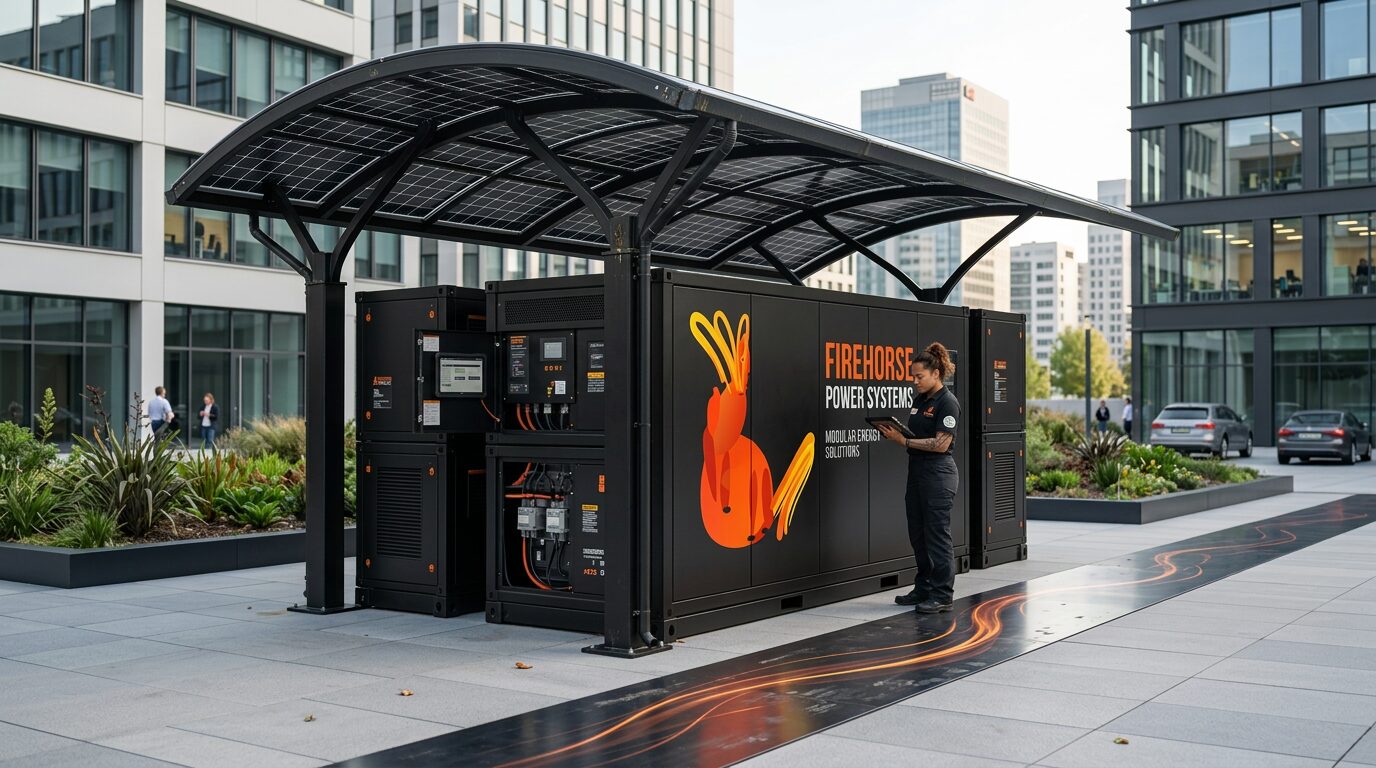
The first is physical: on-site solar PV, optionally paired with battery storage, so a measurable share of the energy your vehicles receive is generated at the point of use. It is the most defensible claim because generation and consumption are co-located and metered together.
The second is contractual: certified renewable supply backed by instruments that track generation and prevent double counting. Done properly — with certificates retired against your actual consumption — it is a legitimate and widely accepted approach. Done loosely, with vague "renewable retail" claims and no retirement trail, it is the kind of statement that gets flagged as greenwashing. The distinction is entirely in the documentation.
The data that has to hold up
For reporting, a renewable claim is only as good as the records behind it. That means per-session energy data (how many kWh, when, to which asset), the source or certificate backing those kWh, and an audit trail that ties the two together. Battery buffering adds a wrinkle worth being honest about: when energy is stored and then dispatched, good systems track the provenance of what went into storage so the renewable attribute follows the electron through to the vehicle, rather than being quietly lost at the battery.
The test to apply to any supplier is simple: ask them to show, for a single charging session last month, exactly where those kWh came from and how the claim is substantiated. A provider built for provenance can answer immediately. One relying on grid averages cannot.
Why it is worth the rigour
Fleet electrification is often justified partly on emissions, and that justification is exactly what stakeholders, customers and regulators will probe. Traceable, well-documented renewable provenance turns a soft claim into a reportable number — one that supports scope-2 accounting, survives an audit, and holds up in a tender where sustainability is scored. In a country already near the top of the world for renewable generation, the opportunity is not to make a vague green claim; it is to make a precise, defensible one.
Sources: MBIE New Zealand Energy Quarterly, March 2026 (94.5% renewable generation; record solar output); MBIE quarterly data, December 2025 (96.4% record).